Blog / Social

Blog

All Social New Inventory News Finance Pre-Owned Inventory
2024 BMW iX vs. 2023 Tesla Model X

New Electric SUVs Face Off: BMW iX vs. Tesla Model X

When asked about rival automakers, which ones come to mind? Toyota vs. Honda? Ford vs. Chevy? Maybe even Lamborghini vs. Ferrari? Well, it’s time to consider a new one: BMW vs. Tesla. Specifically, the BMW iX vs. the Tesla Model X. Tesla overtook BMW as the United States' top-selling luxury brand in 2022, according to estimates by the Automotive News Research & Data Center. The iX and Model X are these brands’ electric SUVs, the most sought-after body style today. Add these models’ comparable prices, specifications, and features to the mix, and you have the recipe for a fascinating competition. So, which is better – the new 2024 BMW iX or 2023 Tesla Model X? Let’s find out. Price Winner - 2024 BMW iX It costs more to get into a new Tesla Model X than a BMW iX. Each model has two trim levels, and the iX xDrive50 base's starting MSRP is $11,390 less than the Model X's entry price. The Model X's premium trim level, the Plaid version, starts a shade lower in price than the iX M60 upper trim. However, additional costs for features like Autopilot and charging equipment on the Plaid make the apples-to-apples pricing comparison close to even. The iX also has better purchase incentives, with monthly lease payments potentially costing several hundred dollars less than the Model X. 2024 BMW iX Charging At Home Performance Winner - 2023 Tesla Model X If you're looking to win a drag race, or one across the country, the 2023 Tesla Model X is the way to go. The Model X's 0-60 miles per hour times are 2.5 and 3.8 seconds respectively. The iX models clock in at 3.6 and 4.4 seconds. The Model X also has longer battery range EPA estimates, and the Plaid version's horsepower reaches an incredible 1,020. BMW iX & Tesla Model X Trim Level Specifications 2024 BMW iX xDrive50 VS 2023 Tesla Model X $87,100 MSRP $98,490 Dual Motor All-Wheel Drive Drive Type Dual Motor All-Wheel Drive 516 Horsepower 670 4.4 seconds 0-60 Time 3.8 seconds Up to 307 miles Range Up to 348 miles Standard Sunroof Not Available Standard Android Auto Not Available Standard Apple CarPlay Not Available Standard Amazon Alexa Not Available Up to 5 Seating Capacity Up to 7 195 inches Length* 198.3 inches 77.9 cu ft Cargo Capacity* 88 cu ft. 41.5/40.2 inches Front Row Head/Leg Room* 41.7/41.1 inches 41.5/38.9 inches Second Row Head/Leg Room* 41/38.7 inches *Same on other trim levels. 2024 BMW iX M60 VS 2023 Tesla Model X Plaid $111,500 MSRP $108,490 Dual Motor All-Wheel Drive Drive Type Tri Motor All Wheel Drive 610 Horsepower 1,020 3.6 seconds 0-60 Time 2.5 seconds Up to 296 miles Range Up to 333 miles 9 Exterior Colors 6 30-speaker Bowers & Wilkins Audio 22 speakers Standard Post-Collision Safety System Not Available Standard 12 Months of Provided Satellite Radio Service Not Available Up to 5 Seating Capacity Up to 6 Features Winner - 2024 BMW iX The 2024 BMW iX tops the 2023 Tesla Model X in terms of comfort and safety features. The inside of an iX offers a more luxurious environment. For starters, mobile app connectivity via Apple CarPlay and Android Auto is not available on either Model X trim level. On the iX, they come standard. The Model X does not have a sunroof. The iX xDrive50 includes a panoramic sunroof, with the M60 featuring an electrochromic shading one. Audio feature advantages in the iX include a powerful 30-speaker Bowers & Wilkins system on the M60, and a year of complimentary satellite radio service on both trims. The iX's riding experience is more comfortable than the Model X, particularly when traveling along bumpy terrain, because of its higher ground clearance (8.8 inches vs. 8.1 inches). The Model X and iX are packed with safety features, but the iX has more standard ones like traffic-sign recognition and hands-free parking assist. 2024 BMW iX Interior Overall Winner - 2024 BMW iX With a more luxurious ride and less luxurious price tag, the 2024 BMW iX beats the 2023 Tesla Model X. Not every buyer is the same, however, and the Model X's power and range advantages are undeniable. It's also important to note that if you need to transport a large group, the Model X can seat a few more people. Chances are you'll like either electric SUV. We just think you'll like the iX more. New BMW iX SUVs For Sale

Selling A Car To A Dealership

Eight Reasons Why You Should Sell Your Car to a Dealership Instead of Privately

Do you have a car you’re trying to sell now or in the near future? If so, you’re probably thinking about selling it on a third-party website like Autotrader, Facebook Marketplace, or eBay Motors. However, before crafting that listing and clicking publish, you should instead take your vehicle to a dealership. Here are eight benefits of selling your used car to a dealership instead of doing it yourself: 1. It's Fast 2. You Might Get More Money 3. It's Safe 4. It's Easy 5. Less Paperwork Responsibilities 6. Legal Protection 7. No Negotiating (Unless You Want To) 8. You Don’t Have to Buy a Car in Return 1. It's Fast If you don’t have the time, or don’t want to spend a lot of it on selling your car, bring it to a dealership. Effectively selling a car privately - whether it be via a buy/sell website, a neighborhood app like Nextdoor, or making a “for sale” sign to place on the vehicle (yes, people still do that) - takes some work. You need to research the vehicle’s value on a trusted resource like Kelly Blue Book, take exterior and interior pictures of the car, and provide important information in your listing like mileage and condition. After that, it’s a matter of hoping for the best while not knowing how long it will take for the car to sell. Dealerships, on the other hand, have professionals who can efficiently assess the value of your car. You can often get an offer within a matter of minutes and complete the sale that same day. 2. You Might Get More Money According to perception, you’ll get less money by selling your car to a dealer. Internet valuation tools such as KBB provide higher estimations for private selling than selling to a dealer (aka trade-in value). However, this perception isn’t always reality. While it’s true that the current state of new car supply is better than it was in late 2021 and 2022, which caused used car values to skyrocket, it’s still possible to get a great offer. This is especially true if the car is less than five years old with fewer than 50,000 miles. Look at the used car inventories of your make’s local dealerships, and see if they have certified pre-owned vehicles of your model. If they don’t have any in stock, or very few, but it’s typically a popular car, you may get a high offer. For example, let’s say you own a 2020 Toyota RAV4 Hybrid that’s in good condition and found a local Toyota dealer that doesn’t have any. You could get more by selling it to that dealership than privately. It’s also important to note that March 2023 marks three years since the COVID-19 pandemic started. U.S. auto plants were shut by stay-at-home orders, and many dealerships temporarily closed. As a result, fewer people purchased new vehicles with three-year lease terms. With cars that come off lease representing a significant portion of a dealership’s used inventory, and less of those vehicles coming back, used car values could rebound with more dealerships needing your car. 3. It's Safe Selling a car privately can be risky because you’re giving contact information, such as your physical address, to total strangers. You don’t know if these people are dangerous. They could also be a scammer paying with a check or money order that bounces. Cash can eliminate that possibility, but not a lot of people like carrying that around. At a dealership, you can rest assured that you’re in a safe environment and that their checks will clear. 4. It's Easy Selling a car privately can quickly become stressful. Once your vehicle is listed, you must handle what often becomes a massive influx of inquiries. These messages include offers, many of which are significantly lower than your car’s value, questions, and test drive requests. Templated replies, such as Facebook Marketplace’s “Hi, is this available?”, enable prospective buyers to send sellers a message with just one click. It’s then your responsibility to vet these replies. By comparison, selling to a dealer is streamlined. Someone at the dealership, often the used car sales manager or an appraiser, will determine your car’s value and make an offer. Contrary to popular belief, many dealers will even show you current auction prices and the other evaluation tools they use by request. 5. Less Paperwork Responsibilities Dealerships have the resources and expertise to handle all the paperwork required for the sale of your car. What that entails varies from state to state, but typically includes Certificate of Title, the Bill of Sale, and the Release of Liability. When selling a car privately, it’s easy to make a mistake. This could be anything from cancelling your auto insurance policy before the transaction is complete to not signing over the title correctly. 6. Legal Protection Let’s say you just sold your car privately, and it breaks down soon afterward. There is a chance you could be held liable. When you sell to a dealership, however, you’re generally protected from any legal action. 7. No Negotiating (Unless You Want To) The private car-selling process often results in last-minute negotiation attempts. While some expect, and even enjoy this, many others don’t want to deal with it. If you are one of the latter, rest assured that haggling won’t occur at a dealership unless you want to negotiate another offer. 8. You Don’t Have to Buy a Car in Return It’s already been a few years since the microchip shortage crippled new car production and forced dealerships to increase efforts on raising used car inventory levels. This meant launching marketing campaigns like buying cars from customers without obligations to buy vehicles. Fast forward to today, and there is still a misconception that you need to buy a car when selling one to a dealership. The fact of the matter is that a dealership will be more than happy to just add a quality pre-owned vehicle to its stock. There is no obligation to buy. And when you consider what was mentioned above, about used car values potentially on the rise, now might be a good time to sell to a dealership. Get a Fair Price by Selling Your Used Car to the Sloane Automotive Group As a result of these eight reasons, we suggest selling your vehicle to a dealership instead of privately. If you are looking for a buyer in the Philadelphia, PA area, consider the Sloane Automotive Group. We have seven dealerships throughout Philadelphia, Glenside, Warrington, Devon, and Malvern. Backed by over 50 years of automotive experience, our knowledgeable and friendly team will make you a fair offer based on the latest market conditions. Contact us online or call us today. We look forward to helping you sell your car.

2023-Toyota-Rav4-Hybrid-Versus-Highlander-Hybrid

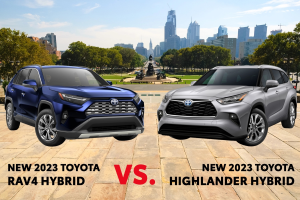
2023 Hybrid SUV Showdown: RAV4 vs. Highlander

The Toyota RAV4 and Toyota Highlander are popular vehicles, each playing roles in revolutionizing the SUV segment over the last two-plus decades. More recently, these models introduced hybrid vehicles to their lineups. Now, consumer interest is at an even higher level. If you’re considering a new 2023 RAV4 Hybrid or Highlander Hybrid, you’ve come to the right place. Let the Sloane Automotive Group, which has three Toyota dealerships in Pennsylvania ( Philadelphia, Glenside, and Malvern), be your guide. We have provided everything you need to know about making an informed decision. The Case for Fuel Economy Typically, fuel efficiency is the No. 1 reason why people buy hybrid vehicles. They are generally more fuel-efficient than traditional gasoline-powered vehicles, which can save drivers money on gas over the long term. United States fuel prices increased approximately $1 per gallon over the last two years (2020-2022). EVs (Electric Vehicles) have even lower operating costs, but limited range and charging stations make them risky to take on long trips. Hybrids provide a happy medium. Hybrid technology has also improved significantly in recent years, making these vehicles more reliable and easier to maintain. In terms of the RAV4 and Highlander hybrids, there are significant fuel economy differences between them and their gasoline counterparts. The 2023 RAV4 Hybrid gets an estimated 41 miles per gallon in the city and 38 mpg on the highway. That is 14 additional mpg in the city, and three-more on the highway, than the non-hybrid new RAV4. The new Highlander Hybrid gets an estimated 36 mpg in the city and 35 mpg on the highway. That is 13 additional mpg in the city, and six-more on the highway, than the non-hybrid 2023 Highlander. Between the two hybrid SUVs, if fuel savings is your top priority, the RAV4 Hybrid is the better option. It gets a combined four additional mpg (40 vs. 36). Shop Now: New 2023 RAV4 Hybrid SUV 2023 Toyota RAV4 Hybrid Front Seats 2023 Toyota Highlander Hybrid Front Seats The Case for Affordability There is no way getting around it. Hybrid vehicles come with higher upfront costs than traditional gasoline-powered ones. This is largely due to the additional technology and specialized components that are required to power them, such as the integration of two separate power sources (the internal combustion engine and the electric motor) into a single vehicle. The Highlander and RAV4 are no exception. Starting MSRP (Manufacturer Suggested Retail Price) for the non-hybrid 2023 Highlander is $36,430. The 2023 Highlander Hybrid’s MSRP begins at over $40,000. The new RAV4 Hybrid nearly costs an additional $3,000 over its gas-powered counterpart. However, the 2023 RAV4 Hybrid starts at approximately $10K less than the Highlander Hybrid. If a lower payment is your main objective, go with the RAV4 Hybrid. Model Comparison 2023 RAV4 Hybrid 2023 Highlander Hybrid Starting MSRP* $30,225 $40,220 Engine 2.5-liter four-cylinders 2.5-liter four-cylinders Horsepower 219 243 MPG Estimates** 41/38 36/35 Seating Capacity Up To 5 Up To 8 Front-Wheel Drive Not Available Available All-Wheel Drive Standard Available Towing Capacity 1,750 lbs. 3,500 lbs. Cargo Area 37.5 cu.ft/69.8 cu.ft*** 16 cu.ft/48.4 cu.ft/84.3 cu.ft**** NHTSA Safety Ratings***** 5 out of 5 Stars 5 out of 5 Stars *MSRP is not the sales price and does not include taxes, tags, title. adjusted market value, dealer installed equipment (if applicable), and dealer documentary fee. **city/highway. ***behind front/second-row seats. ****behind front/second-row/third-row seats. *****National Highway Traffic Safety Administration Crash Test Results. The Case for Space The RAV4 and Highlander, along with other SUVs, rose to prominence by offering more passenger and cargo space, making them more suitable for families than sedans. By the same token, they are more stylish and ruggedly designed than their station wagon predecessors. The RAV4 is a compact SUV. Its hybrid and non-hybrid variants offer two rows with enough room for five passengers. Hybrid and gas-powered Highlanders have optional third rows that boost passenger capacities to eight people. Additionally, when the third row is folded down, the Highlander provides 48.4 cubic feet of cargo area. With its second row folded down, the RAV4 checks in at 37.5 cubic feet. It’s also important to note that the new 2023 Highlander Hybrid can tow double the weight of the RAV4 Hybrid. If having enough room for your family and belongings is most important to you, the new Highlander Hybrid is the way to go. Shop Now: New 2023 Highlander Hybrid SUVs Highlander Hybrid Second and Third Rows RAV4 Hybrid Panoramic Glass Roof The Case for Features The new 2023 RAV4 and Highlander SUVs are packed with safety, comfort, and technological features. These are available over a multitude of trim levels. The RAV4 Hybrid has seven trims. The Highlander Hybrid has five. Below is a look at each one’s highlights, in order of lowest starting MSRP to highest. RAV4 Hybrid LE: All-Wheel Drive Integrated Management with Multi-Information Display monitor, Electronically controlled Continuously Variable Transmission with sequential shift mode, 17-in. 5-spoke light gray metallic alloy wheels. RAV4 Hybrid XLE: LED projector-beam headlights with chrome-finished bezels, Smart Key System on front doors and liftgate, Integrated fog lights. RAV4 Hybrid Woodland Edition: 6-spoke bronze-colored TRD flow-formed alloy wheels and Falken® WILDPEAK All-Terrain tires, Woodland all-weather floor mats and cargo liner, One 120V/100W AC power outlet in cargo area. RAV4 Hybrid XLE Premium: 18-in. multi-spoke Super Chrome-finished sport alloy wheels, SofTex®-trimmed * seats and power-adjustable driver's seat with available two-position memory function, Power tilt/slide moonroof. RAV4 Hybrid SE: 18-in. multi-spoke black-painted sport alloy wheels, Fabric-trimmed seats with sporty blue stitching and power-adjustable driver's seat, Bi-LED projector low- and high-beam headlights with LED accent lights. RAV4 Hybrid XSE: 18-in. multi-spoke black-painted sport alloy wheels, Two-tone exterior color, SofTex®-trimmed * seats and power-adjustable driver's seat. RAV4 Hybrid Limited: 18-in. multi-spoke Super Chrome-finished sport alloy wheels, All-Wheel Drive Integrated Management with Multi-Information Display monitor, SofTex®-trimmed * seats and power-adjustable driver's seat with two-position memory function. Highlander Hybrid LE: 8.0-in. Toyota Audio Multimedia with six speakers, and wireless Android Auto™ & Apple CarPlay® compatibility, Five total USB ports, 7-in. color LCD Multi-Information Display. Highlander Hybrid XLE: 18-in. machined-finish alloy wheels, Power tilt/slide moonroof with sunshade, Qi-compatible wireless smartphone charging with charge indicator light. Highlander Hybrid Bronze Edition: 18-in. bronze-colored alloy wheels, Illuminated front doorsill metal scuff plate with bronze finish, SofTex®-trimmed front- and second-row seats with fabric inserts and bronze-colored stitching. Highlander Hybrid Limited: 20-in. chrome-finished wheels, 12.3-in. Toyota Audio Multimedia with wireless Android Auto™ & Apple CarPlay® & Amazon Alexa compatibility, Height-adjustable hands-free power liftgate with jam protection. Highlander Hybrid Platinum: Power Panoramic View Moonroof with sunshade and one-touch open/close with jam protection, 10-in. color Head-Up Display, LED projector headlights with Adaptive Front-Lighting System, auto leveling and LED-strip Daytime Running Lights. Despite offering less in trim level quantity, the new Highlander Hybrid includes more quality throughout its lineup - particularly when it comes to safety. On the base Highlander Hybrid LE, a backup camera with projected path is standard. It's not available on the RAV4 Hybrid's entry trim, called the LE, too. Also standard on the Highlander Hybrid's LE trim - a blind spot monitor with rear cross-traffic alert. This is only available on the RAV4 Hybrid LE as part of an option package. Last, but not least, the Highlander comes in standard front-wheel drive and available all-wheel drive. The RAV4 comes in standard all-wheel drive. If having more options at your disposal is your top goal, we suggest the Highlander Hybrid over the RAV4 Hybrid. 2023 RAV4 Hybrid vs. 2023 Highlander Hybrid: The Verdict So, what’s better, the RAV4 Hybrid or Highlander Hybrid? As much as we, at the Sloane Automotive Group, would like to pick an overall winner, the truthful answer is it depends. For fuel efficiency and affordability. The RAV4 beats the Highlander. For space and features, the Highlander defeats the RAV4. Upon reading this blog, we suggest determining which factors are most important for you and your family’s needs. But rest assured. No matter which Toyota hybrid SUV you select, you will end up with a reliable vehicle with top-notch resale value. Want to take an even deeper dive? You’re in luck. Research all our Toyota hybrid models. Check out our online inventory for a plethora of new Highlander and RAV4 hybrids for sale. Use our "Sloane at Home" feature to build your deal online. This fast and secure tool streamlines the purchase process by enabling you to obtain accurate finance and payment information without having to step inside our Philadelphia-area Toyota dealerships. From there, you can also schedule a test drive. However, if you have additional questions, feel free to contact us and we will get back to you shortly. We look forward to serving you and know you’re going to love the new 2023 RAV4 and Highlander hybrids. You Might Also Be Interested in Reading: Toyota RAV4 Hybrid vs. Toyota RAV4 Toyota RAV4 Hybrid Configurations

Daytona 2023

BMW Joins Battle in LMDh

BMW made a brief but very strong statement in prototype racing in the late 1990s. The V12 LMR claimed victory at the 24 Hours of Le Mans and 12 Hours of Sebring in 1999, two of the most significant endurance races in the world. BMW Motorsport has remained active and successful in GT racing since then, but the new worldwide regulations for top-tier prototypes have enticed some of the strongest motorsports programs in the world to rediscover that thrill of competition. BMW has now confirmed a two-car entry in IMSA’s LMDh class beginning at the 24 Hours of Daytona in 2023. IMSA and the ACO made waves in 2020 by announcing a plan of convergence for the top classes of sports racing across the globe, allowing cars to run the world’s most famous endurance races such as Daytona and Le Mans. Manufacturers have flocked to this idea with the lofty goals of winning these races outright, with BMW as the latest to confirm a factory-backed program—though there has not been an indication that the program will be traveling overseas just yet. The LMDh platform is a cost-saving formula that combines spec components with manufacturer-supplied power and design, ensuring that budgets stay competitive but each team has the ability to create a package that looks and sounds true to the brand. The powertrain will be a hybrid unit, with a universal electric motor being paired to each team’s bespoke petrol engine. The underpinning chassis is LMP2-based and is available from one of 4 different constructors. BMW has not yet confirmed any of these details but is expected to do so soon. BMW has a strong commitment to GT3 around the world with the next generation set to hit the track this year. The M4 GT3 will be the competitor to take on the Nürburgring, Spa, and IMSA’s North American rotation in GTD and GTD-PRO. But BMW M CEO Markus Flash said he is a “strong believer that there is room on top of GT3,” and the latest forecasts show a flurry of competitive energy moving into LMDh.

GT World Challenge

GT World Challenge Delivers Competitive Action to Fans at VIR

For the first time since the March 2020 weekend at Circuit of The Americas, GT World Challenge hosted unrestricted fan access for the latest round at VIRginia International Raceway. Even with the typical oppressive heat that permeates VIR during the summer, sports car racing proved irresistible and the fans were treated to incredible action across several classes of motorsport. SRO America assembles professional racing from production-like touring cars to purpose-built GT cars, and several stages in between. GT3 is the premier class running 90-minute races with a pair of drivers, with GT4 separately running its two-driver races as well. Touring cars range from the Honda Civic to the BMW M2 CS, and compete in single-driver races with each class running alongside each other. For the VIR weekend, the paddock also welcomed the Porsche Sprint Challenge and Lamborghini Super Trofeo, delivering nonstop racing action throughout the weekend. Wright Motorsports’ consistency builds points lead in Pro-Am The perennial Porsche powerhouse of Wright Motorsports knows how to set up a 911 GT3R to compete for wins against anyone. Despite running in the Pro-Am class against a number of full Pro teams, the #20 GT3R stayed at the sharp end of the field throughout the weekend whether it had the relentless Jan Heylen or Fred Poordad at the helm. Starting 5th overall in Race 1, Poordad kept the #20 in the top 5 until the driver change, where Heylen took over and maintained the top 5 standing until the end, earning P2 in the Pro-Am class. Race 2 began with Heylen behind the wheel, who pressured the overall leader during his entire stint before Poordad hopped back in and cruised to a comfortable P4 and second in class once again as attrition claimed a number of competitors throughout the weekend. With these results in hand, the Wright team cushions its season points lead in the Pro-Am division. Aging M6 GT3 proves it can still get it done with Turner BMW’s GT3 competitor is scheduled for imminent replacement, but Turner Motorsport is proving that the outgoing M6 is still more than capable of delivering results. The Pro tandem of Robby Foley and Michael Dinan steered clearly and consistently for a second overall finish in Race 1 and landed on the class podium in Race 2 as well. With the M4 GT3 on the horizon, the front-engined M6 is still powering its way onto podiums across the world. Nolasport keeps streak going, then breaks it In the first four rounds of GT4 America, the #47 Cayman GT4 of the Nolasport team was the example of dominance, winning overall each time out. After taking overall pole for Race 1 at VIR, it seemed those winning ways were destined to continue. This time, the overall winner was the #72 Mercedes of Murillo Racing, but the Nolasport Cayman came to the checker right behind it and still earned a class win to make it a perfect 5-for-5 on the season. But the unpredictability of a massive GT4 field, along with the unforgiving nature of VIR, meant that incidents would keep the #47 Cayman off the top step of the podium, settling for P2 in class and third overall. It’s certainly not a result anyone would complain about, but for a team so used to being the one to beat, second place can be tough to swallow. Ruud’s dominance continues in the M2 CS In a spec field, which is essentially what TCX is as it consists solely of the BMW M2 CS, driver talent shines above the supposed advantages or disadvantages of BOP or a certain car. This alone make’s Jacob Ruud’s streak of success this season so much more remarkable. Every round of the 2021 season has ended with Ruud’s #81 M2 leading the pack and often by a considerable margin, and the story remained the same at VIR, though Race 2 shows as a tight gap simply because the race was concluded early by a red flag. Luck rings true in shortened GT America sprint The GT America series places a single driver against the field for 40 minutes, though Race 1 at VIR saw significantly less race time than that. Due to a variety of incidents, including a major one prompting a lengthy safety car period, the pole-sitting 911 GT3R of Charlie Luck found itself at the front of the field when the red flag turned to checkers. The win was Luck’s first overall this season, but adds to numerous class victories on the season including another in Race 2 of the weekend. Quinlan leads competitive GT4 field in GT America The multi-class nature of GT America makes for unpredictable moments, but the BMW M4 GT4 of Sean Quinlan stayed up front and out of the drama, winning both races from pole over the weekend. Quinlan pulled double duty in the #119 M4, also securing a second in class finish in Race 1 of GT4 America. Porsche Sprint Challenge welcomes biggest field of the season The Porsche Sprint Challenge offers aspirational racers a visible and accessible platform to hone their skills with factory race machines such as the Porsche 911 GT3 Cup and the Cayman GT4 Clubsport. The series visits some of the most famous tracks in North America, but Round 4 at VIR saw the biggest turnout of the season thus far, with more than 30 cars taking the green for the race sessions. The field is divided between the 991.2 Cup car (Platinum), the 991.1 (Gold) and the Cayman GT4 Clubsport (Silver), but driver experience varies significantly among the field. Nonetheless, Alan Metni claimed overall victory in both races with Grant Talkie taking the Gold class, and Ben Waddell and Eric Filgueiras splitting the weekend in Silver.

Contact Us

Fill out this form below and we'll contact you shortly
*Required Fields